
APRIL 27, 2026
MARKET BRIEF
Bali Hotel | H2 2025
Bali Hotel | H2 2025


Bali’s hotel market in H2 2025 showed continued supply growth, with seven new hotel openings adding 351 rooms, particularly within the upscale to luxury segments. However, demand softened, as reflected by a decline in occupancy rates despite an increase in international arrivals, mainly due to weaker domestic tourism and external pressures. Adaptive strategies, including a focus on domestic demand and enhanced regulatory oversight of unregulated accommodations, supported by clearer policy frameworks for short-term rental platforms, are expected to support market performance for 2026 and ahead.

|
Seven new hotel openings contributed 351 rooms to Bali’s supply in H2 2025
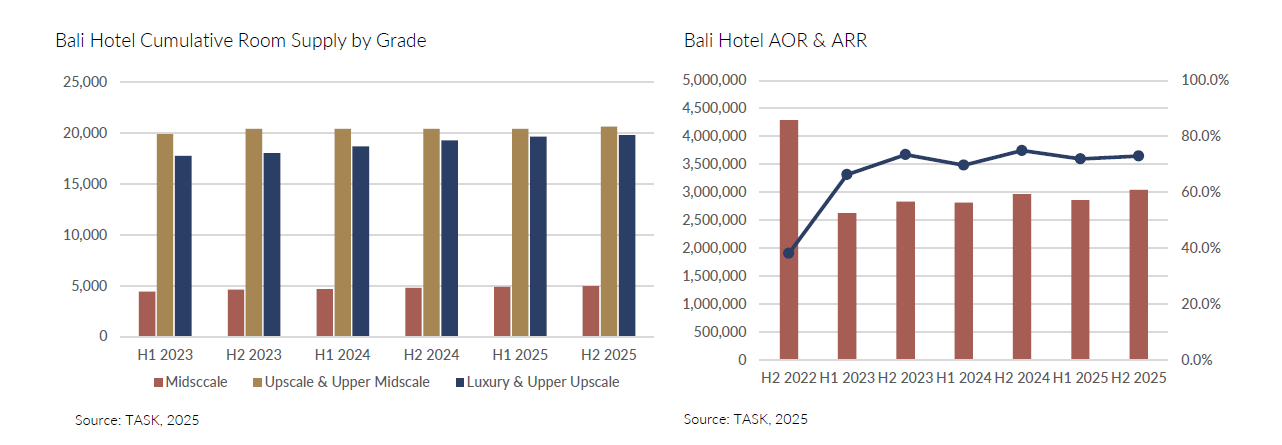
During the period from July to December 2025, Bali welcomed seven new hotel openings. Kleo Seminyak (4-star), Fairfield by Marriott Bali Kuta Ngurah Rai (4-star), The Arden Villa Uluwatu (5-star), Equipoise Resort and Spa Ubud (5-star), Maar Resort Ubud (5-star), Sanggraloka Resort Ubud (5-star), and Asvara Resort Ubud (5-star), located across Uluwatu, Seminyak, and Ubud. The addition of these hotels contributed a total of 351 rooms, further expanding Bali’s cumulative supply within the upscale to luxury segments. While 4-star hotels continue to dominate the market, the 5-star segment maintains a strong development pipeline. |

|
Bali’s average occupancy rates declined in the second half of 2025
Bali’s average occupancy rate in the second half of 2025 decreased by 2.69% year-on-year to approximately 72.9%. Despite an increase in foreign arrivals, domestic tourist visits to Bali declined. This decline can be attributed to several factors, including high travel costs, the absence of extended public holidays, extreme weather conditions, and shifting travel preferences toward overseas or local destinations. Additionally, the presence of unregulated accommodations, including short-term rental platforms such as Airbnb, has further pressured hotel occupancy rates. |

|
ADR remained stable while RevPAR shows modest growth
The Average Daily Rate (ADR) of hotels in Bali remained at around IDR 3,046,000 in the second half of 2025. Compared to the previous semester, the figure rose by approximately 2.59%. In the same period, Revenue per Available Room (RevPAR) was estimated at approximately IDR 2,196,000, marking a 5.64% increase from H1 2025. |

|
Benoa Port positioned as one of Bali’s cruise tourism gateway
Port of Benoa is set to become a homeport for cruise ships bringing international tourists to Bali. This initiative is part of a National Strategic Project (PSN) led by PT Pelabuhan Indonesia (Pelindo), namely the Bali Maritime Tourism Hub (BMTH), which aims to position Bali as a world-class maritime tourism hub. The port reportedly handled 65 cruise ship calls, bringing a total of approximately 140,000 international visitors in 2025. BMTH is designed to integrate the tourism, port, and entertainment sectors, thereby generating a multiplier effect on economic growth. |

|
Flooding disrupted tourism activity, triggered policy response in Bali
Floods that had occurred across Bali in September 2025 temporarily disrupted tourism activity, particularly in the Denpasar area and its surroundings. Although no flight delays or cancellations were reported, the conditions are likely to have had a modest impact on overall tourist arrivals. Furthermore, the government introduced a moratorium policy shortly after the floods, indicating a direct policy response to environmental pressures arising from rapid tourism-related development. |
APPENDIX: ECONOMIC INDICATORS
